
 English
 Português
 Deutsch
 Magyar
 Español
 Polski
MyClaw Deploys OpenClaw in 30 Seconds. Then the Real Work Begins.
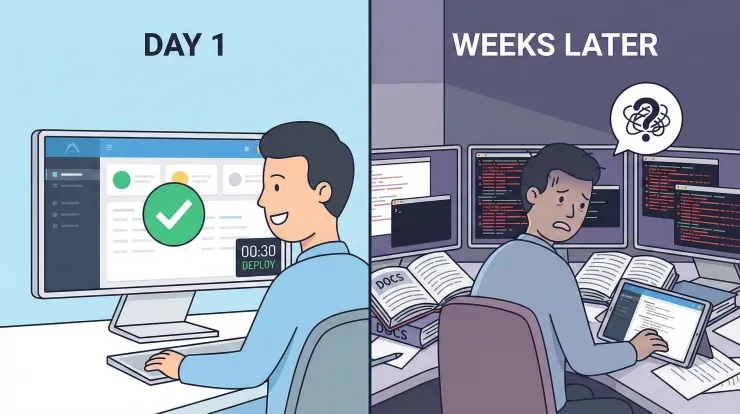
MyClaw solved the hardest 10% of the OpenClaw problem: setting up a server. No Docker. No SSH. No VPS. Click a button, and your OpenClaw instance is running in 30 seconds.
But nobody on the MyClaw landing page mentions this: setup is not the hard part. The hard part is what comes after.
"I spent the first two weeks babysitting, burning tokens, and watching my agent loop on the same answer eight times in a row." — r/openclaw user, 510 upvotes
If you are a solopreneur who just wants admin handled, not a new side project to maintain, keep reading.
What Is MyClaw.ai?
MyClaw is a managed hosting service for OpenClaw, the open-source AI agent platform. Instead of setting up your own server, MyClaw gives you a dedicated cloud instance with automatic updates, daily backups, and 24/7 uptime.
MyClaw is the easiest way to get OpenClaw running. Credit where it is due. Their setup takes 30 seconds versus 4-6 hours for self-hosting. They handle updates, backups, and server maintenance so you do not have to.
The question is not whether MyClaw makes OpenClaw easy to deploy. It does. The question is whether OpenClaw itself is the right tool for you, regardless of who hosts it.
The Problem That Hosting Does Not Solve
MyClaw gives you a working OpenClaw instance. But a working OpenClaw instance is a blank slate. It does not know your business, your clients, or your schedule. You still have to:
1. Configure everything from scratch.
OpenClaw out of the box does nothing useful. One r/openclaw community member who spent weeks getting it working put it bluntly:
"Out of the box OpenClaw is dumb. It will loop, repeat itself, forget context, and make weird decisions. You need to add guardrails... anti-looping rules, compaction summaries, task checking. The agents that work well are the ones with heavily customised instruction sets." — r/openclaw, 510 upvotes
That means writing SKILL.md files, creating memory structures, setting up cron jobs, configuring model routing, and testing every workflow by hand. One user who documented their full setup spent weeks on trial-and-error.
2. Manage memory constantly.
OpenClaw forgets things mid-conversation. There is no warning; it just drops context when the window fills up. One power user wrote a 3,000-word guide solely about fixing this problem, involving SQLite databases, vector search, decay classification, and daily file scanning. His takeaway:
"Session memory dies on compaction. If it's not saved to a file, it's gone. This is the number one mistake new users make." — r/openclaw, 345 upvotes
Cora remembers your preferences and business context automatically. No SQLite. No vector databases. No manual memory management.
3. Pay unpredictable LLM costs on top of hosting.
MyClaw's hosting fee ($19-79/month) covers the server. It does not cover the AI models that make OpenClaw work. Those are billed separately through API keys you provide.
One detailed r/openclaw guide broke down real monthly costs:
- Setup: ~$42 in Claude Opus tokens just for initial configuration
- Ongoing: ~$60/month in API costs (carefully optimized with model routing)
- The user reports spending "a few grand on tokens" total across his experimentation
Another user described a nightmare scenario:
"It got caught in a doom loop once — no matter what I did couldn't stop it from eating credits/tokens from a variety of services. I still have no idea what happened." — r/openclaw user, 361 upvotes
So your real cost is MyClaw ($19-79) + LLM APIs ($40-100+) = $59-179+/month, with no ceiling and no predictability.
4. Deal with the security reality.
MyClaw runs OpenClaw. OpenClaw has 6 documented CVEs, 824+ malicious skills in its marketplace, and a ZeroLeaks security score of 2 out of 100. Gartner told businesses to block it entirely.
MyClaw handles server security. But you are still installing skills, connecting your email, and giving an AI agent access to your business data on a platform where an independent audit found 41.7% of popular skills contain serious vulnerabilities.
What Week One With MyClaw Actually Looks Like
Based on dozens of r/openclaw posts, here is the realistic timeline for a non-technical user:
Day 1: MyClaw setup works perfectly. 30 seconds. You are impressed. The OpenClaw dashboard loads. You type "check my email." Nothing happens because you have not connected anything yet.
Day 2-3: You spend 2-4 hours connecting your email, configuring API keys, and trying to get the agent to respond on Telegram or WhatsApp. Token pairing fails twice. You end up Googling the error message.
Day 4-7: The agent starts doing things, but inconsistently. It drafts an email but forgets the context from your last conversation. It loops on a task and burns $8 in tokens before you notice. You start reading r/openclaw guides about memory management.
Week 2: You are deep into writing SKILL.md files, setting up cron jobs for recurring tasks, and debugging why your morning briefing cron timed out at 3 AM. One community member summarized this phase:
"The people posting 'my agent built a full app overnight' have spent weeks tuning. The gap between the demo and daily use is real. It's closing fast, but it's still there." — r/openclaw, 510 upvotes
Week 3+: If you are technical and persistent, you have a functional system. If you are a solopreneur who just wanted their receipts processed, you have spent 20+ hours and over $100 in tokens, and you still do not have a working receipt scanner.
Cora vs MyClaw.ai: Honest Comparison
| Feature | Cora | MyClaw.ai |
|---|---|---|
| What you get | Working AI secretary from minute one | OpenClaw instance you configure yourself |
| Setup time | 3 minutes (WhatsApp + Google login) | 30 seconds for hosting + days/weeks for useful config |
| Monthly cost | $0-199/mo (everything included) | $19-79/mo hosting + $40-100+/mo in LLM APIs |
| Cost predictability | Fixed pricing, no overages | Unpredictable; doom loops can burn tokens overnight |
| Email triage + drafting | Works immediately, learns your style | Requires manual configuration, skill setup, and memory management |
| Receipt processing | Snap a photo on WhatsApp | Requires custom skill + OCR integration |
| Voice notes | Core feature, works natively | Requires Whisper API setup + custom skill |
| Memory | Automatic, persistent | Manual management required ("dies on compaction") |
| Interface | Web dashboard, Telegram/Discord (with config) | |
| Security | TEE-based, no CVEs | Inherits OpenClaw's 6 CVEs and malicious skill ecosystem |
| Customization | Opinionated (supported workflows only) | Unlimited (full OpenClaw flexibility) |
| Self-hosting control | No | Yes — full access to your instance |
| 24/7 autonomous agents | No (task-based) | Yes (cron jobs, sub-agents, heartbeats) |
| Best for | Solopreneurs who want admin done | Technical users who want a configurable AI agent |
Where MyClaw wins: If you want a fully customizable AI agent that can browse the web, write code, manage your Kubernetes cluster, integrate with 15 different services through custom skills, and run autonomous tasks overnight, MyClaw gives you that on a managed server. Cora does not offer that level of customization.
Where Cora wins: If you want to send a voice note after a meeting and get a follow-up email drafted, process a receipt by taking a photo, or have your inbox triaged every morning, Cora does that now, today. No weeks of configuration. No memory management scripts. No unpredictable API bills. No security vulnerabilities.
The Real Cost Comparison
MyClaw.ai (realistic solopreneur setup):
- Hosting: $39/month (Pro tier) = $468/year
- LLM APIs: ~$60/month (optimized) = $720/year
- Setup cost: ~$42 in initial tokens
- Time investment: 20-40 hours first month, 2-4 hours/month ongoing maintenance
- Total first year: $1,230+ plus 40+ hours of your time
Cora:
- Starter: $49/month = $588/year
- LLM costs: included
- Setup time: 3 minutes
- Maintenance: zero
- Total first year: $588 plus 3 minutes of setup
Even at $50/hour, the 40+ hours of OpenClaw configuration in month one adds $2,000+ in opportunity cost. A solopreneur billing $150/hour loses $6,000 worth of billable time learning to be a DevOps engineer.
Who Should Still Choose MyClaw
MyClaw is the right choice if:
- You are technical and enjoy configuring AI agents
- You want autonomous agents running 24/7 tasks (code reviews, web scraping, outreach campaigns)
- You need integrations with specific tools that Cora does not support
- You want to experiment with different LLM models and custom skills
- You treat your AI agent as a project, not just a tool
MyClaw does hosting well. If you have already decided OpenClaw is what you want, MyClaw is one of the better ways to run it.
Who Should Choose Cora
Cora is built for you if:
- You do not want to configure anything. You want it to work when you send a message
- Your needs are email, calendar, receipts, meeting notes, and client messages, not custom AI pipelines
- You work from your phone and WhatsApp is already your primary communication tool
- You do not want to learn about model routing or memory management
- You want a predictable monthly bill with no surprise API charges
- You looked at OpenClaw and realized you need a secretary, not a server
The Secretary vs. Server Question
Every OpenClaw managed host (MyClaw, ClawCloud, EasyClaw, Agent37) solves the same problem: "How do I run OpenClaw without being a DevOps engineer?"
But the question most solopreneurs are actually asking is different: "How do I stop spending 2 hours a day on admin work?"
Those are not the same question. One gives you a server. The other gives you a secretary.
Try Cora Free — 50 Actions, No Credit Card
Start with 50 free actions per month. Forward an email. Snap a receipt. Send a voice note after your next meeting.
No API keys. No model selection. No memory management. No skill marketplace. No doom loops.
Open WhatsApp and say what you need.
Try Cora Free — 50 Actions, No Credit Card
Last updated: February 23, 2026. MyClaw.ai pricing sourced from myclaw.ai. OpenClaw community quotes from r/openclaw with post scores noted. Security data from Gartner, ZeroLeaks, and Northeastern University research. Cora is a product of Cora AI. This page is maintained for accuracy — if anything is out of date, contact us.